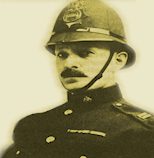
Testimony of Mr. George F. Lumb
Chairman WALSH: State your name, please.
Mr. LUMB: George F. Lumb.
Chairman WALSH: What is your business?
Mr. LUMB: I am the deputy superintendent of the department of
State police of Pennsylvania. . . .
Chairman WALSH: How long have you been connected with the
Pennsylvania State Constabulary?
Mr. LUMB: It is the State police. Since its
organization—if you will permit me, I would like to make a correction as to the use of
the word “constabulary.” That word has been used throughout the examination of the
witnesses, but its proper name under the statues of the State of Pennsylvania is the
“State Police.”. . . .
Chairman WALSH: Now, I would like you to make just one
statement. You stated, going back to 1906, where waitresses and others refused to serve the
men, and coming down to the situation where they had to go to the steel company’s
property, how do you account for the prejudice or the lack of sympathy that seems to exist in
these towns toward your force? What is the cause of that?
Mr. LUMB: Now, my answer to that, Mr. Chairman, would be more
in the nature of a personal opinion than an official statement.
Chairman WALSH: Well, I thought perhaps you had inquired into
it and discussed it?
Mr. LUMB: Yes; I will be glad to give you my opinion on the
subject, but I would want to state before doing so that this department, in time of disorder,
does not take any notice of the fact that a strike exists from that standpoint. It is with us
purely a question of the man that throws the brick or fires the gun or burns the tipple; and
we do not ask if he is a Republican or a Democrat or a union or nonunion man. It is a question
of law or lawlessness on the public highways and the destruction of property.
Now, having cleared the air, so that you will not think this is
an official expression of views of the department, I want to say this:
That my knowledge of the old English guilds and various earlier
labor unions is that they were for the purpose of protecting the men and raising a boycott, if
necessary. They did not at that time seem to recognize the powerful importance of violence
toward others who wanted to work. Perhaps it was due to the fact that the populations were not
as dense at that time. Now, it has been held in Pennsylvania that if a man wants to go on a
strike he has a perfect right to do so; but that he must not obstruct the highways to prevent
other men who wish to work from going on to their work. The Supreme Court, in 1860 or 1861,
held that there were no innocent bystanders in time of riot; that it was the duty of every
law-abiding citizen, as soon as he hears or learns that there is any disorder on the public
thoroughfare, to retire to his home. Those facts being true, and it also being true that the
labor unions deny any responsibility for violence—they ordinarily, I believe, claim that
most of the violence comes from the class of men who just enjoy such excitement, and that it
is not officially recognized by the union as a proper thing. I think they are all agreed now
that that is the attitude they generally take—that it is not done by one of “our
men”; “he is a fellow that came here from Baltimore.” They dynamited street
cars in Chester, and cars were blown up, and the unions denied any responsibility for it, and
perhaps justly so. I have personal knowledge of the fact that men did come there from
Baltimore, and even Philadelphia, and some of them even wearing their conductors' caps, and
performed these very acts. If this is true, I can not understand why the labor union, as such,
should object to the presence of men who are sent there by the proper authority of the
Commonwealth to enforce law and order. But I am greatly afraid, particularly from what I have
heard from Mr. Maurer and Mr. Pierce and Mr. Williams, that there is creeping into our labor
unions a sort of spirit abroad of anarchy, and I don’t believe they voiced the sentiments
of labor unions at large. I don’t believe they voice the general opinion; and their zeal
against our institution is so far-reaching as to be sanctioned by the opinion of the majority
of the labor unions of Pennsylvania. That is about as well as I can express it from my
personal standpoint.
Chairman WALSH: Then you think this lack of sympathy which you
discovered is through the influence of those persons which you have mentioned?
Mr. LUMB: Well, I think—no—every member of the
commission must know that there has recently been injected into our country some people from
Europe—some people who call themselves Industrial Workers of the World. About three or
four years ago there was a strike on the B. & S. Railway, up in Potter County—the
Buffalo & Susquehanna. And their attorney, Mr. Robinson, came down to Harrisburg and said,
“Capt. Lumb, we have got to have some men.” He said, “The sheriff up there,
because of the scarcity of the population, except those who are on the strike, is such that he
can not get enough deputies to protect us. And the men are putting sand in the journal boxes
of the engines and putting soap in the boilers, and are doing everything possible to destroy
the property and imperil life and our rolling stock, and the State must send some State police
up there.” I said, “Mr. Robinson (or Roberts, whichever it was) it is impossible to
send men under those conditions.” "Why?“ he says, ”the Industrial Workers
of the World are up there, and they are preaching treason and anarchy, and there is a reign of
terror among us people, and we don’t dare to go out after dark.“ I said, ”that
is a bad state of affairs in Pennsylvania, but you have got to go to your sheriff, and your
sheriff can go to the governor or the superintendent of Pennsylvania and certify in writing
that the situation is beyond his control before our men can go on the scene."
He stated that the sheriff was a high-strung man who had so
much pride in his office that he would not concede that the situation was beyond his control,
and that the only question was not being able to get enough men to serve as deputies. Now, as
a matter of fact, we did not send any men up there, because the request came from the
corporation and not from the proper authorities.
That, I think, is the menace to the labor unions themselves
that this wrongful spirit is creeping in and undermining their proper attitude of mind toward
law and order. But understand, Mr. Chairman, this is purely a personal opinion, based on
purely personal observation.
The department of the State police keep no data of labor
unions. We have no information about their workings. We never try to attend their meetings. We
do not recognize in our official capacity that there is such a thing as a labor union. When we
go into a place at the request of a sheriff we are under his directions. He says at this
particular point there was bloodshed last night, or at this place they are going to dynamite
property, or here is a mob; and under his directions alone we go in and under his directions
alone we go out, and the sheriff is the high peace officer of the county in Pennsylvania.
Commissioner LENNON: Is it not a fact that nearly all the
criticism against the State police originates from their work in strikes, labor troubles? I
have not heard a bit of criticism of your course in all of the other duties you perform for
anything else.
Mr. LUMB: Yes, sir; that is quite true; and perhaps I can throw
a little light on that situation by this statement: Before the organization of the State
police force the National Guards were under the fire that we are under now, and if you abolish
the State police force you will see the attention of these same people directed toward the
National Guards again.
Commissioner LENNON: I am not a citizen of the State of
Pennsylvania and will not take any part in an attempt to abolish the force. Is it not possible
that if the men in charge of the police force, when they go to a strike zone, will start
giving the same attention to the representatives of the strikers as to the representatives of
the employing company—certainly if that is done at all, in so far as conferring with them
as to the necessary means of maintaining peace and good order, and not be on the property of
one less you divide your men and put half on the property of the other—would not merely
the doing of those things be self-evident and beyond question that the police have no
favoritism of any kind, shape, or description to either side in a labor controversy;
wouldn’t that eliminate a good deal of this?
Mr. LUMB: I would like to say in answer to your question, in
the first place when the State police go into a community under those conditions they go in
under the direct orders of the sheriff, and you heard the report of Capt. Thomas, which was
brought down here as a specimen, and there are hundreds of others on file along with it. In
that particular instance Capt. Adams reports that he had a conference with a committee of the
strikers, and they came to an agreement as to that bridge, and they were to have 20 pickets. A
good deal depends upon the situation where the strike exists. For instance, if there is a
strike in a soft-coal region, and if you will examine the census report of 1910 as to the per
cent of foreign population of Pennsylvania, particularly with references to that region, you
will find that perhaps two-thirds of the men on strike are actually foreign-born men, either
Italians or from south Europe. The minute our men arrive on the scene in their uniforms they
are hissed at and jeered at and usually meet with a shower of stones. To reason with them is
an absolute impossibility. With reference to distributing our men, as to the assignment of
property, some going on the company’s property -
Commissioner LENNON: I don’t think they should go on
either one.
Mr. LUMB: I will try to cover that in my limited way. The men
in arriving at a town go to every place providing for public accommodation in hotels and
livery stables; and they find that they have been preceded by organizers, who have notified
those men that if they gave the State officers their accommodations they would be boycotted
forevermore and they might as well go out of business, and the condition depends upon their
attitude when we arrive. We would be glad to put up in places where the accommodation is
better than on barn floors, and make them eat off of tin plates and drink out of tin cups.
These men are men that first had to satisfy the Army recruiting officer that they were
citizens of the United States and of good moral character. I speak from 12 years' experience
in the Regular Army in peace and in war.
There are two classes of men—the Army makes or breaks a
man. The man that is broke is what they call “bobtailed” or discharged without
honor; and if the temptations of the new life are too great and he becomes in the habit of
getting intoxicated, etc., and disgraces his uniform, after five or six summary offenses he is
discharged without honor and can not be re-enlisted. The other class are made. They learn
self-restraint and self-control and patriotism and learn love of country in the post schools,
one of which I had the honor to teach in Fort McHenry, Md. The American soldier of to-day,
gentlemen, is no thug; he is a pretty well-trained young man, with a good head, or he
won’t get through with his enlistment. If he don’t come up to the grammar-school
education the troop commander finds it out and details him to attend school, which is during
the summer months. They may, after they first establish the fact that they are men of
employment and moral character, make application to attend that school. Look at the saving in
economy to take such men in preference to citizens that we have to look up through various
private sources, and then have to depend upon limited observation. A man comes in with an
excellent discharge as a sergeant of the Fifteenth Cavalry, and that means that he is not only
learned to command himself, but others, and that he is an American citizen above all, and
knows the laws to a certain extent, and knows the Constitution of the United States. He is
detailed for four months of special duty as policeman. He is taught the fish, game, and
forestry laws, and we have had cases where they have deceived us; that the man didn’t
seem to take any particular interest in the study; that he thought it was going to be an easy
life, and he didn’t want to study any more like he had had to in the Army, so he dropped
at the end of his probation period; and on the other hand, if they satisfy us of their good
moral conduct they remain on the force.
Commissioner GARRETSON: Is there not one qualification that you
have not mentioned that is of greater importance for your purpose than anything; that the man
who served as a regular soldier learned one further lesson, and that was when he received a
command to fire he would obey, regardless of who stood in front, which is one of the things
that the citizen soldier has not learned?
Mr. LUMB: That is true, and it is true also that the soldier
has learned to shoot accurately and not to shoot the innocent man.
Source: Testimony, May 6, 1915. U.S.
Congress, Senate, Final Report and Testimony Submitted to Congress by the Commission on
Industrial Relations, 64th Cong., 1st sess., S. Doc. 415, vol. 11 (Washington: Government
Printing Office, 1916), 10932ff. |